
Last updated: · Published by WalkingAids.net · How we review products
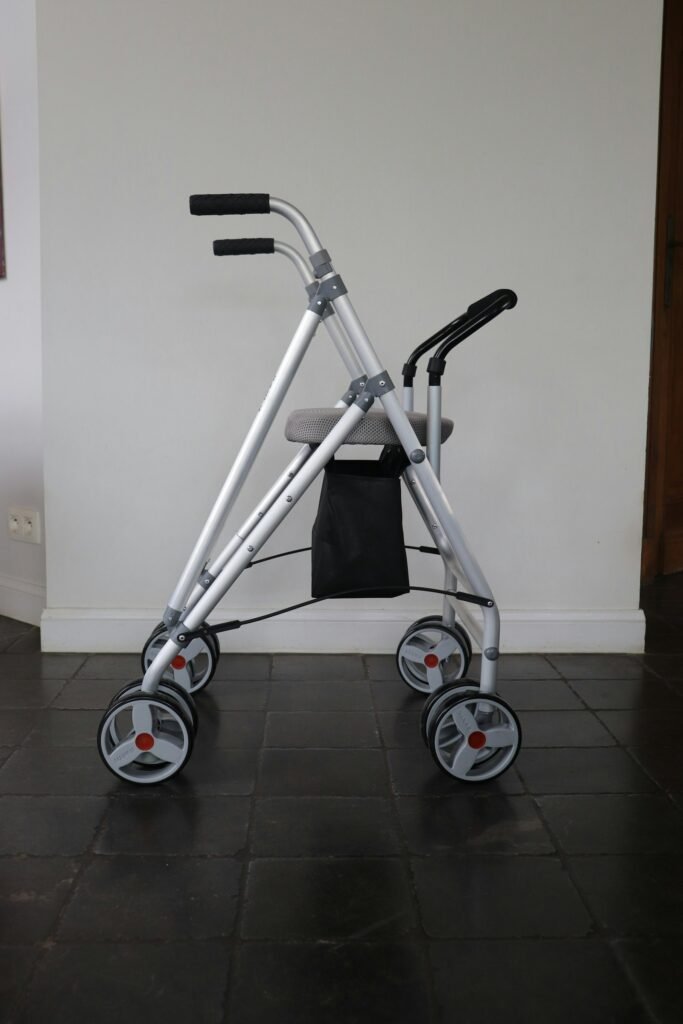
A rollator is a walking frame with wheels, hand brakes and usually a seat, so you can walk further and rest on the way. It is for balance and confidence, not for leaning your full weight on. This guide covers who a rollator suits, the brakes, the right height, sitting safely, kerbs, three or four wheels, and what to check before you buy, with diagrams. It applies wherever you live.
At a glance
Sources: American Family Physician, 2021; American Family Physician, 2011; NHS Lanarkshire.
Who a rollator suits
A four-wheeled walker is “useful for higher functioning patients who do not need the walker to bear weight”. It is “not appropriate for patients with significant balance problems or cognitive impairment”, and “it can slide out from under a patient when the handle brakes are not engaged” (American Family Physician, 2011; American Family Physician, 2021).
A hospital physiotherapy service lists people a four-wheeled walker can help:
- “If you have reduced balance, strength or endurance when walking”
- “If you have pain, weakness or instability in any part of your leg, for example hip, knee or ankle”
- “Shortness of breath impacting on distance walked”
Sources: NHS Lanarkshire, Walking aid: 4 wheel walker.
If you need to lean your weight on an aid, a walking frame is usually safer.
Parts of a rollator
Types of rollator
| Type | What it is | Good for |
|---|---|---|
| Four-wheeled | Four wheels, two brakes and a seat. | Most people. You can stop and sit down. |
| Three-wheeled | One front wheel, so narrower and lighter. Most have no seat. | Narrow spaces, shops, homes with tight turns. |
| Lightweight | Aluminium or carbon frame. | Lifting into a car or onto a bus. |
| Outdoor or all-terrain | Larger, wider wheels. | Grass, gravel, uneven paths and kerbs. |
| Indoor | Small and narrow, often with a tray. | Carrying meals and drinks around the home. |
| Heavy-duty (bariatric) | Wider seat and higher weight limit. | People above a standard rollator’s weight limit. |
| Rollator and transport chair | Turns into a chair someone else can push. | Walking some of the way and being pushed the rest. Only push it in chair mode, as the maker describes. |
Setting the height
The handles go at the same height as for any walker: “at the level of the patient’s wrist crease”, with your elbow slightly bent (American Family Physician, 2011). Stand up straight between the handles in your usual shoes, arms by your sides, and set both handles to your wrist crease. Both handles must be at the same height.
The brakes
- Lever brakes: squeeze the levers to slow down. “Push down to lock position to check wheels are not moving.”
- Pressure brakes: they work when you push down on the handles. “Test by pushing down.”
- On slopes: “Keep your fingers lightly on the brakes to control the speed of the frame.”
- If your grip is weak, try the brakes in the shop: some levers need more strength than others.
Sources: NHS Lanarkshire.
Walking with a rollator
-
Open and lock
“Ensure that the frame is fully open and locked when being used.”
-
Both hands on
Keep both hands on the handles, with the rollator about one step ahead.
-
Walk tall
“Do not walk too far into the frame or push the frame too far ahead of you.” Stand upright, do not hunch over the handles.
Sources: NHS Lanarkshire.
Using the seat
Sources: American Family Physician, 2011; NHS Lanarkshire.
More in using a rollator safely.
Kerbs and slopes
- Going up: “Roll the frame fully up onto the kerb”, then step up with your stronger leg first, followed by the weaker leg.
- Going down: push the rollator over the edge until all four wheels are on the lower level, hold it with the brakes, then step down with the weaker leg first.
- Downhill: keep your fingers on the brakes and take small steps.
- Use dropped kerbs and ramps where you can.
Sources: NHS Lanarkshire.
Safety checks
- “Regularly check your walking frame.”
- “Check the joints on the frame are not loose.”
- Test the brakes before each trip, using the test for your brake type.
- Check the tyres for wear and the wheels for hair or thread wrapped round the axles.
- If anything is worn or loose, stop using it and get it repaired.
Sources: NHS Lanarkshire.
Buying checklist
Rollators vary more than any other walking aid. Check these before you buy:
- Handle height range covers your wrist-crease measurement.
- Seat height: when you sit, your feet should rest flat on the floor with your knees at about a right angle.
- Seat width is comfortable, and the maximum user weight is above your weight.
- The rollator’s own weight, if you will lift it into a car or onto a bus.
- Folded size fits your car boot (measure it).
- Wheel size: bigger wheels roll better over kerbs, grass and rough paths; smaller ones turn more tightly indoors.
- Brakes you can squeeze and lock with your hand strength.
- Width fits through your doorways at home.
- A bag or basket you can reach, and a backrest if you will sit often.
Rollator or walking frame?
| Walking frame | Rollator | |
|---|---|---|
| Stability | Highest | Lower: it rolls |
| Takes your weight | Yes | No |
| Where | Mostly indoors | Indoors and outdoors |
| Speed and distance | Slow, short distances | Normal pace, longer walks |
| Seat | No | Usually |
| Brakes | Not needed | Yes, must be used |
See walking stick, frame or rollator for all three side by side.
What it is called around the world
The same aid has different names around the world, which matters when you search or shop. More in walking aid names by country.
| Country | Usual name |
|---|---|
| UK, Ireland, New Zealand | Rollator |
| United States | Rollator, rollator walker |
| Canada | Rollator, wheeled walker (ambulateur in Quebec) |
| Australia | Wheelie walker, four-wheeled walker |
| Germany | Rollator |
| France | Rollator, déambulateur à roues |
| Spain | Andador con ruedas, rollator |
Prices and help with costs in your country
Help with the cost of a rollator differs a lot between countries. Choose yours for local details.
-
United Kingdom
Rollator
Prices, help with costs and where to buy in the United Kingdom.
-
United States
Rollator
Prices, help with costs and where to buy in the United States.
-
Canada
Rollator, wheeled walker
Prices, help with costs and where to buy in Canada.
-
Ireland
Rollator
Prices, help with costs and where to buy in Ireland.
-
Australia
Wheelie walker
Prices, help with costs and where to buy in Australia.
-
New Zealand
Rollator
Prices, help with costs and where to buy in New Zealand.
-
Deutschland
Rollator
Preise, Kostenübernahme und Bezugsquellen in Deutschland.
-
France
Rollator
Prix, remboursement et où acheter en France.
-
España
Andador con ruedas
Precios, ayudas y dónde comprar en España.
Common questions
Is a rollator the same as a walker?
A rollator is a walker with wheels, brakes and usually a seat. In Australia it is often called a wheelie walker.
Can I lean my weight on a rollator?
No. It is for balance and support while you walk. If you need to lean on an aid, ask about a walking frame.
Can someone push me on the seat?
Not on a standard rollator. Some models convert into a transport chair; use those only in chair mode, as the maker describes.
Three wheels or four?
Three-wheelers are narrower and turn tightly but usually have no seat. Four-wheelers are more stable and let you rest.
How high should the seat be?
Sitting down, your feet should rest flat on the floor with your knees at about a right angle.
Can I use a rollator on stairs or an escalator?
Not on stairs. Escalators are not safe with a rollator either; use a lift.
Tools and reference
- ISO 11199-2 and other rollator standards, and a printable safety checklist
- Doorway width checker to see whether a rollator fits your doors
- What rollators are called in 27 languages
- Rollators compared: weight, seat height, wheels and width for 13 models
- Folded sizes and car boots
- How reliable are walking aid listings?