
Published 19 November 2026 in the WalkingAids.net Journal (Conditions). Sources checked 19 November 2026. Written by the WalkingAids.net editorial team. Not medically reviewed: no doctor, physiotherapist or occupational therapist has checked this article.
Most walking aids are used by older people, and many are bought by family members as a gift or after a scare. A well-chosen, well-fitted aid helps people stay active. A badly chosen one can make falls more likely. This guide is for older adults and the people who help them.
Start with an assessment, not a shop
A physiotherapist or occupational therapist can watch you walk, check strength and balance, and suggest the right aid. American Family Physician grades the advice to check the fit and use of devices people got without professional guidance as a recommendation, because poorly fitted aids are common (Sehgal M, Jacobs J, Biggs WS. Mobility Assistive Device Use in Older Adults. American Family Physician 2021;103(12)). The same review warns that aids “may in fact cause falls if patients do not use them correctly”.
In the UK, the NHS says you can borrow a walking frame or some sticks from the NHS, and that a local authority may provide a frame free after a needs assessment (NHS). For other countries, see who pays for walking aids in 19 countries.
Matching the aid to the need
| Main difficulty | Often suggested | Read more |
|---|---|---|
| Mild unsteadiness, one painful leg | Walking stick, held opposite the painful leg | Walking sticks |
| Poor balance indoors | Standard or two-wheeled frame (the most stable types) | Balance problems |
| Tires quickly, needs to rest outdoors | Four-wheeled rollator with seat, if balance is good enough | Fatigue |
| Can walk only short distances | Wheelchair or mobility scooter for longer trips | Wheelchairs, scooters |
The table follows the device-to-need lists in the American Family Physician reviews (2021; 2011). It is a starting point for a conversation with a therapist, not a prescription.
Common mistakes we see in buying questions
- Buying a rollator for balance. A four-wheeled rollator suits people who need little weight-bearing support. It “can roll forward unexpectedly” (AAFP 2011). If the main problem is balance, ask about a frame.
- Wrong height. The top of a stick or frame should sit at the wrist crease with arms hanging relaxed (AAFP 2011). Use the measurement guide.
- Too wide for the home. Measure doorways before ordering: doorway width checker.
- Using a relative’s old aid. NHS leaflets ask people not to lend aids or change their height settings (Aneurin Bevan UHB), because they were set up for one person.
Reducing falls at home
- Clear clutter, loose rugs and trailing wires (NHS).
- Do strength and balance activities at least twice a week (NHS).
- Wear a personal alarm or carry a mobile phone (NHS).
- If you fall, “Take your time – do not get up too quickly” (NHS).
- Ask for a review if walking changes. See when a walking aid needs reassessing.
Sources
All checked on 19 November 2026. Where a source is older or past its own review date we say so in the text.
- Sehgal M, Jacobs J, Biggs WS. Mobility Assistive Device Use in Older Adults. American Family Physician 2021;103(12):737-744 (published 15 June 2021).
- Bradley SM, Hernandez CR. Geriatric Assistive Devices. American Family Physician 2011;84(4):405-411 (published 15 August 2011).
- NHS: Walking aids, wheelchairs and mobility scooters (page reviewed 8 April 2026).
- NHS: How to prevent falls (page reviewed 6 March 2025).
- Aneurin Bevan University Health Board: Care and safe use of your walking aid (PIU1208/5) (September 2026).
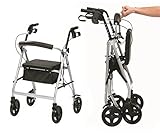
Popular rollators on Amazon UK
These are Amazon UK's current bestsellers, shown automatically. They are not our picks and we have not tested them. Prices come from Amazon and can change. Check the size, weight limit and returns policy before you buy.



Related on WalkingAids.net
- Walking stick, frame or rollator?
- Walking aids when you live alone
- Ageing populations and walking aids: the data
- Walking Aids Index
- Free walking aids in the UK
About this article. We wrote it from the published sources listed above; we have not tested the equipment or assessed anyone. It is general information, not advice for you, and it does not replace an assessment by a physiotherapist, occupational therapist or doctor. Read our editorial policy. Spotted an error or out-of-date source? Tell us and we will recheck it.