
Last updated: · Published by WalkingAids.net · How we review products
Walking aid guides for Australia. Which government scheme can help pay for a walking aid depends on your situation, so this page starts with the main ones.
Who can help pay for a walking aid?
Three government schemes mention walking aids by name. Each one decides who qualifies.
| Scheme | Who it’s for | What it says about walking aids |
|---|---|---|
| NDIS low-cost assistive technology | NDIS participants | “Low-cost assistive technology costs less than $1,500.” Examples include “walking sticks or canes” and “four-wheeled walker frames”. For low-cost, low-risk items you don’t need to send quotes, evidence or assessments first. (NDIS) |
| My Aged Care: equipment and products | Older people approved after an aged care assessment | “Help to stay mobile, such as wheelchairs and walking frames.” (My Aged Care) |
| Support at Home: AT-HM scheme | Support at Home participants | Funding tiers for assistive technology of “Under $500”, “Up to $2,000” and “Up to $15,000+”. Participant contributions apply. (Department of Health, November 2025) |
A physiotherapist or occupational therapist can tell you which aid suits you and set it to the right height. Your GP can refer you.
Our guide explains each scheme, what you pay and how to apply: Walking aid funding in Australia: NDIS and My Aged Care.
Words to know in Australia
- Walking stick or cane: the NDIS uses both, listing “walking sticks or canes”.
- Walking frame: a frame with four legs that you hold in front of you.
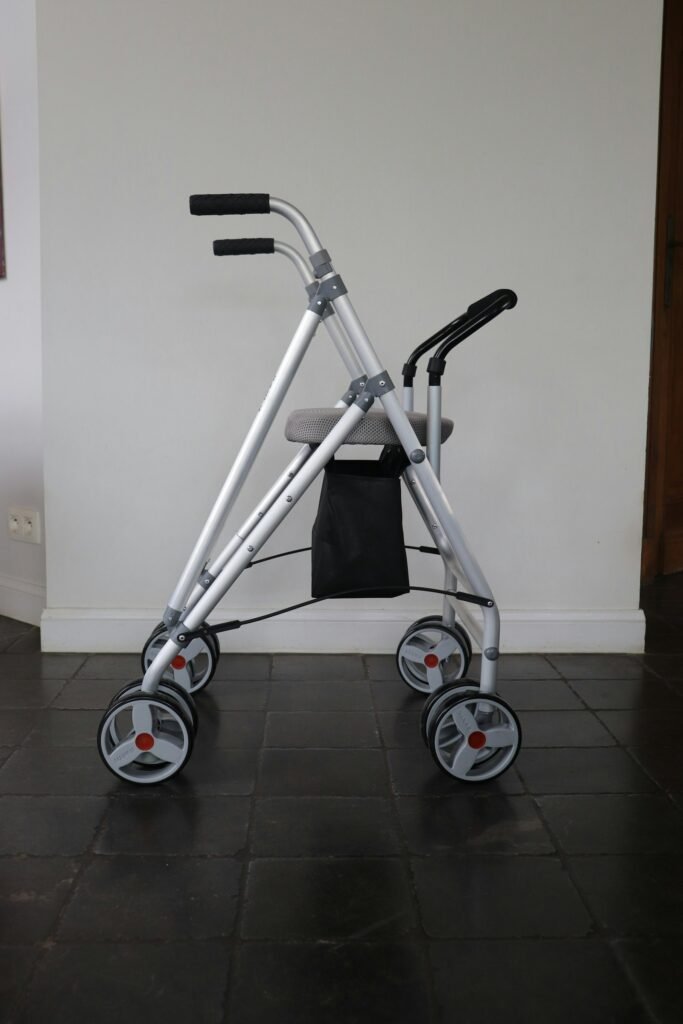
- Wheelie walker or rollator: the NDIS calls these “four-wheeled walker frames”.
Which type of walking aid?
- Walking sticks: light support on one side, for balance or one painful hip, knee or ankle.
- Walking frames: four legs and the most stability, mostly indoors.
- Rollators, often called wheelie walkers: a frame on wheels with brakes and usually a seat.
- Wheelchairs: for longer distances, or when walking isn’t possible.
- Mobility scooters: powered, for getting out without walking far.
Not sure which? Read walking stick, frame or rollator: how they differ.
Buying a walking aid in Australia
If you buy your own, compare the user weight limit, the handle height range and the folded size before price. Our Australian buying guides will compare products from Australian retailers, in Australian dollars, and say clearly whether we tested each product or researched it.
Australian guides
- Walking aid funding in Australia: NDIS and My Aged Care
- Walking aids for veterans: the DVA Rehabilitation Appliances Program
- Walking stick height check: a printable 4-point guide
- Walking stick, frame or rollator: how they differ
- Using a rollator safely: brakes, seat, kerbs and checks
- Walking aid names by country