
Last checked: 21 November 2026.
A walking stick seat, or seat stick, is a stick that opens into a small perch so you can rest in a queue, at a bus stop or on a walk. It is useful if you need to stop often, but it is not a full walking aid: the Disabled Living Foundation says they are “not recommended for people who need to take a lot of weight through the stick” (Living Made Easy). Here is who they suit, the types, and what to check.
Who a seat stick suits
- “These are particularly useful for people who need to rest periodically” (Living Made Easy). The NHS lists “whether you need a seat so you can rest” as one thing to think about when choosing a stick (NHS).
- They suit people who can walk steadily and need short, regular rests, for example with fatigue (see walking aids when fatigue limits how far you can go).
- They are a poor choice if you lean heavily on your stick, because “the addition of a seat alters the balance of the stick” (Living Made Easy). If you need firm support and a seat, a rollator is usually the better tool.
The Disabled Living Foundation advises discussing whether a seat stick suits you with your GP or physiotherapist (Living Made Easy).
Types of seat stick
| Type | How it works | Example listing |
|---|---|---|
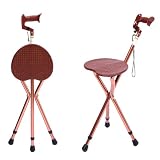
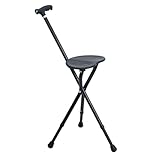
| Tripod stick seat | Three legs open out under a small fabric or plastic seat | Aidapt walking stick seat: seat height 435 mm, maximum user weight 100 kg (Mobility Smart); Economy Stick Seat: seat 51 cm, 780 g, 100 kg (Essential Aids) |
| Flip-up seat stick | A single stick whose handle flips over to form a saddle-style seat | Flipstick: seat height 730 mm. Its maximum user weight is listed as 130 kg (Living Made Easy), and as both 127 kg and 114 kg on one retailer page (Mobility Smart), so check with the seller |
| Shooting stick | A single point with a small plate at the base | The Disabled Living Foundation says traditional shooting sticks “do not provide sufficient stability” (Living Made Easy) |
Seat height matters: “The lower the seat, the more difficult it becomes to stand up”, and “Most do not provide back support or armrests to push up from” (Living Made Easy). A tripod seat at around 43 to 51 cm is a perch, not a chair.
Safety checks
- Check the maximum user weight: “The maximum user weight tolerated by stick seats varies according to their design” (Living Made Easy).
- Only sit on level, firm ground: “Always check the ground is level and stable before sitting” (Mobility Smart).
- “Seat sticks with a single point base must have a rubber ferrule” (Living Made Easy). See our ferrule guide for sizes and free checks.
- Check you can open and close the seat with your hands, since the strength needed varies by model (Living Made Easy).
- Set the handle height: “The hand grip should be at wrist height” (South Tees NHS). Many seat sticks are fixed height, so check the handle height in the listing against our walking stick height calculator.
Getting one: NHS, buying and VAT
“You can borrow some types of walking sticks from the NHS” by asking a GP, physiotherapist, occupational therapist or hospital staff, and you “might have to pay a small deposit” (NHS). Seat sticks are a specialist item, so ask whether one is available; see how to get a free walking aid. If you buy, the NHS says walking sticks cost “£15 to £50” (NHS). If you have a long-term illness or disability you may be able to buy without VAT: see VAT relief on walking aids.
Our best walking sticks in the UK shortlist includes a seat stick for resting while out, with its listed weight limit.
Popular walking stick seats on Amazon UK
Amazon UK's current bestsellers, shown automatically. We didn't choose them, so check the size and weight limit before you buy.


Related reading: Folding walking sticks: who they suit and what to check
More for the UK: UK walking aids hub. By type: Walking sticks · Walking frames · Rollators · Wheelchairs · Mobility scooters. Help with costs: Free walking aids · VAT relief.
Related guides
- Walking sticks: a complete guide
- Walking sticks in the UK
- Walking aids for shopping, days out and holidays
- Zimmer frame, tri walker or rollator
Sources
- Living Made Easy (Disabled Living Foundation): Choosing walking equipment and Flipstick
- NHS: Walking aids, wheelchairs and mobility scooters (reviewed 8 April 2026)
- Mobility Smart: Walking stick seat
- Mobility Smart: Flipstick seat stick
- Essential Aids: Economy stick seat
- South Tees Hospitals NHS: How to use walking sticks (updated 16 October 2023)